

Multi-currency investment ledger matching is one of the most error-prone processes in financial operations. According to industry data, manual reconciliation efforts fail to catch approximately 30% of currency translation discrepancies before the close. These errors stem from timing gaps, exchange rate volatility, and fragmented data sources. As global portfolios expand, the complexity of matching positions across multiple jurisdictions and asset classes increases exponentially. Traditional rule-based engines struggle to handle the nuance of corporate actions and settlement breaks in foreign currencies. This guide details how autonomous AI agents can eliminate these breaks, ensuring a clean, auditable close every time. (About Us Aetherix Systems)
Understanding the Challenges of Multi-Currency Reconciliation
Investment reconciliation involves matching custodian positions against your book of record. When multiple currencies are involved, the margin for error widens significantly. Currency translation risk is the potential for losses due to changes in exchange rates between the time a transaction is initiated and when it is settled. This risk is compounded by the fact that different custodians may use varying exchange rate sources or update rates at different times of the day.
Another critical issue is the handling of corporate actions. When a company in a foreign market issues dividends or executes a stock split, the resulting cash or share adjustments must be accurately reflected in the ledger. If the reconciliation engine does not understand the specific rules of that market, breaks occur. These breaks require manual investigation, which is time-consuming and prone to human error.
Furthermore, intercompany eliminations and multi-entity netting add layers of complexity. For family offices and fund administrators, ensuring that inter-entity balances match across different legal structures and currencies is a daily operational hurdle. Without automated tools, these processes can take weeks to complete, delaying the financial close and increasing operational costs.
The Role of AI Agents in Exception Handling
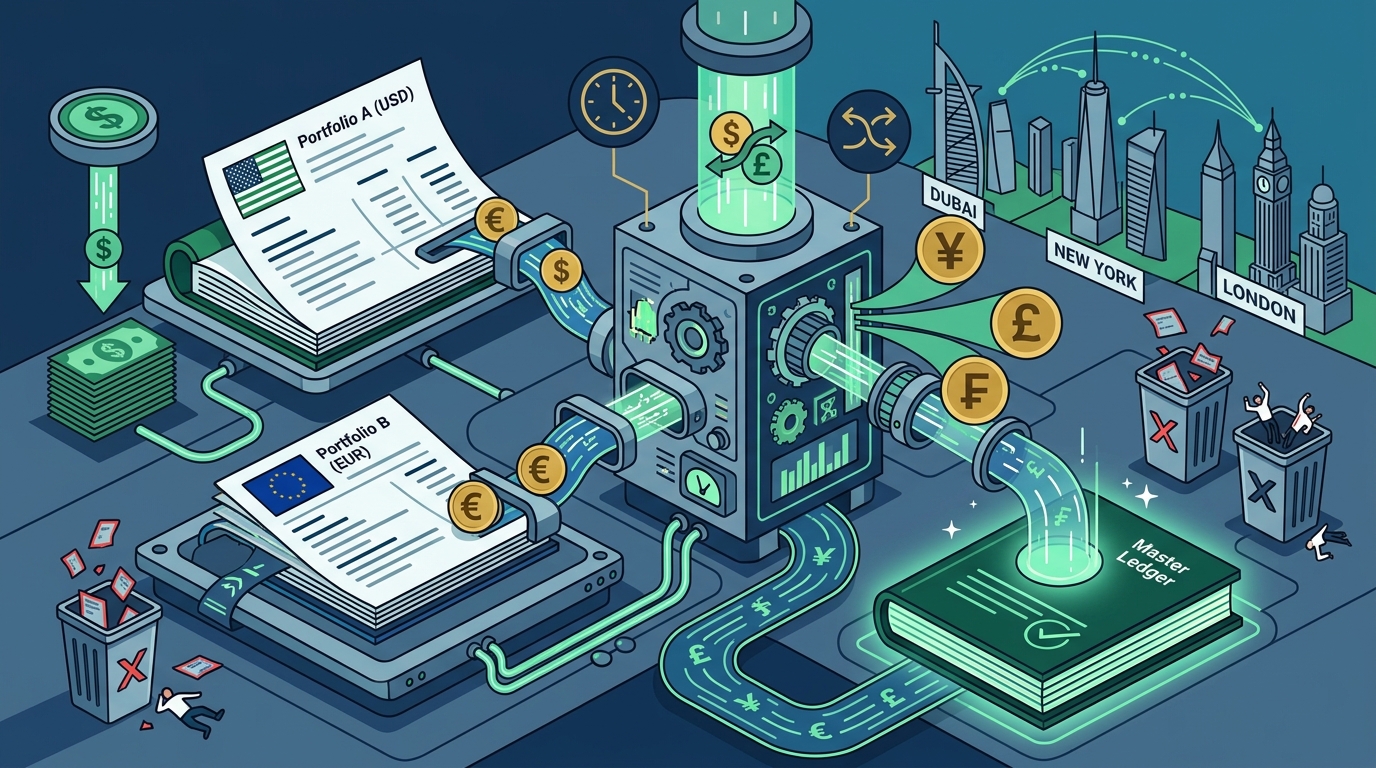
Traditional reconciliation tools focus on matching transactions that agree. However, the real value lies in handling the exceptions. Agent orchestration refers to the coordination of multiple specialized AI agents to manage complex workflows autonomously. In the context of multi-currency matching, these agents work together to ingest data, identify breaks, and propose resolutions.
Unlike static scripts, AI agents can reason through the context of a break. For example, if a cash position does not match, the agent can investigate whether it is due to a timing difference in settlement, a missing fee accrual, or a currency conversion error. It can then propose a resolution based on historical patterns and current data, attaching the full reasoning for transparency.
This approach transforms reconciliation from a reactive process into a proactive one. By automating the investigation phase, teams can focus on high-value activities rather than chasing down minor discrepancies. The result is a faster close and a more accurate financial report.
Ingestion and Auto-Matching Strategies
The foundation of accurate reconciliation is robust data ingestion. Our agents pull data directly from custodians, banks, and internal ledgers. This ensures that the data is fresh and comprehensive. Real-time monitoring allows operations teams to track the status of every task as it is processed, providing visibility into the reconciliation lifecycle.
Once the data is ingested, the auto-matching engine processes positions, cash, and transactions. It uses advanced algorithms to identify matches based on multiple criteria, including transaction IDs, dates, amounts, and currency codes. For transactions that do not match automatically, the agents flag them for investigation.
This hybrid approach of automation and intelligent exception handling ensures that the majority of transactions are matched quickly, while the complex ones receive the attention they need. By integrating with platforms like NetSuite, Sage Intacct, and QuickBooks, the system ensures seamless data flow across your entire tech stack.
Investigating Breaks with Full Audit Trails
When a break is identified, the investigation process must be thorough and auditable. Invoice reconciliation is a key component of this process, involving the three-way matching of purchase orders, goods receipts, and invoices. In the context of investment ledgers, this extends to matching trade confirmations, settlement statements, and internal records.
Our agents research breaks by chasing source documents and analyzing historical data. They propose resolutions based on the evidence found, ensuring that every action is logged and explained. This full audit trail is critical for compliance and internal controls. It allows auditors to trace every decision back to its source, providing confidence in the accuracy of the financial reports.
For example, if a discrepancy arises from a currency conversion, the agent will verify the exchange rate used against the official source at the time of the transaction. If a mismatch is found due to a timing gap, the agent will document the settlement date difference. This level of detail ensures that the close is not only clean but also defensible.
Compliance and Security in Financial Operations
Security and compliance are paramount in financial services. Aetherix Systems maintains rigorous compliance with global data protection regulations, including GDPR, UAE PDPL, and CCPA. Our multi-jurisdictional approach ensures that your data is protected wherever you operate.
We adhere to SOC 2 Type II and ISO/IEC 27001:2022 standards, ensuring that our infrastructure meets the highest security benchmarks. Role-based access controls and encryption at rest and in transit protect sensitive financial data from unauthorized access. Additionally, our compliance with the EU AI Act ensures that our AI agents operate within defined safety boundaries, with human oversight mechanisms built into high-risk applications.
This commitment to compliance extends to data residency. We offer data residency in three regions, allowing clients to choose where their data is stored. This is crucial for institutions with strict regulatory requirements regarding data location. By maintaining these standards, we ensure that your reconciliation operations are not only efficient but also secure and compliant.
Key Takeaways
- AI-Driven Investigation: Autonomous agents investigate breaks, propose resolutions, and attach full reasoning, reducing manual effort.
- Full Audit Trail: Every action and decision is logged, providing transparency and compliance for auditors.
- Enterprise Integration: Seamless connectivity with NetSuite, Sage Intacct, QuickBooks, and Microsoft Dynamics ensures data accuracy.
- Compliance First: Adherence to SOC 2, GDPR, UAE PDPL, and EU AI Act standards protects data and operations.
- Rapid Deployment: Go live in weeks, not months, with minimal disruption to existing workflows.
- Zero Black-Box Decisions: Every resolution is explained, ensuring trust and accountability in the reconciliation process.
- Scalable Operations: Handle complex multi-entity and multi-currency structures with ease, supporting growth.
Frequently Asked Questions
How do AI agents handle currency translation discrepancies?
AI agents verify the exchange rate used against the official source at the time of the transaction. If a mismatch is found, the agent documents the difference and proposes a correction based on the correct rate, ensuring accurate ledger balances.
What is the benefit of using autonomous agents for reconciliation?
Autonomous agents reduce manual effort by investigating breaks and proposing resolutions automatically. This leads to faster closes, fewer errors, and the ability for teams to focus on strategic tasks rather than data entry.
Is the reconciliation process fully auditable?
Yes, every action taken by the AI agents is logged with a full reasoning trail. This provides a complete audit trail for compliance and internal control purposes, allowing auditors to trace every decision back to its source.
Which financial platforms does Aetherix Systems integrate with?
We integrate with major platforms including NetSuite, Sage Intacct, QuickBooks, Microsoft Dynamics, Bill.com, and Ramp. This ensures seamless data flow and accurate reconciliation across your entire tech stack.
How does Aetherix Systems ensure data security?
We maintain SOC 2 Type II and ISO/IEC 27001:2022 compliance. Our infrastructure includes role-based access controls, encryption at rest and in transit, and adherence to global data protection regulations like GDPR and UAE PDPL.
Can AI agents handle intercompany eliminations?
Yes, our agents handle intercompany eliminations, multi-entity netting, and GL-to-subledger matching. They ensure that balances across different legal structures and currencies are accurately reconciled.
What is the typical deployment timeline?
Deployment is typically completed in weeks, not months. Our agents are designed for rapid integration and immediate value, allowing you to see results quickly without disrupting your operations.
Next Steps for Your Operations
Reduce errors and accelerate your close with Aetherix Systems. Our AI agents provide the reliability, security, and speed needed for modern financial operations. Contact our sales team to discuss your specific needs and schedule a demo. Book a demo today to see how our agents can transform your reconciliation process.