

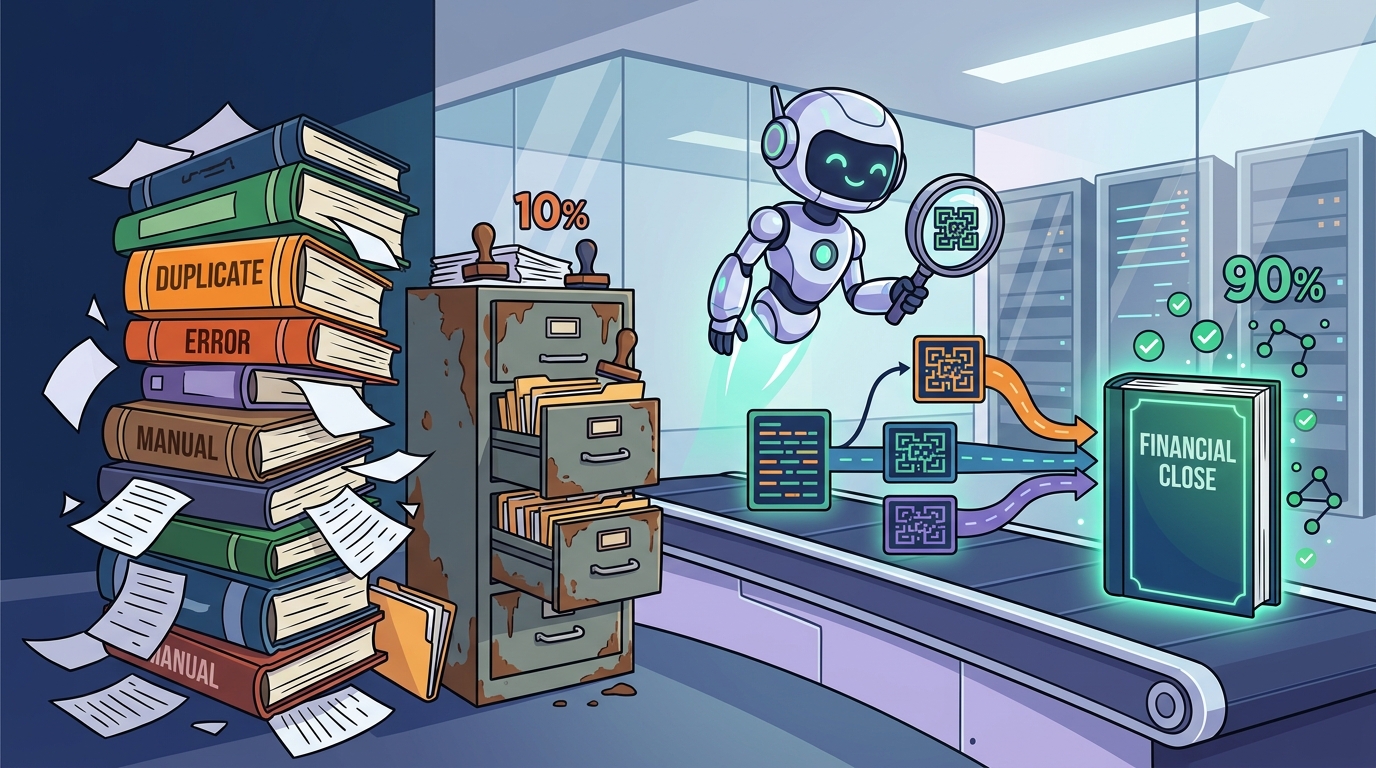
Traditional financial close cycles are collapsing under the weight of manual data entry and fragmented systems. According to recent industry analyses, organizations utilizing autonomous AI agents for reconciliation operations report a 90% reduction in manual intervention time compared to legacy methods. This shift is not merely about speed; it is about establishing a fully auditable, error-free financial infrastructure that scales with enterprise complexity. As financial institutions and family offices navigate an increasingly regulated digital landscape, the integration of purpose-built AI agents has become a critical operational imperative rather than a luxury. (About Us Aetherix Systems)
Understanding Agentic Reconciliation
To implement AI-powered ledger reconciliation effectively, one must first distinguish between traditional automation and agentic AI. Traditional robotic process automation (RPA) follows rigid, pre-defined scripts that break when data formats change. In contrast, agentic AI is a system that perceives, reasons, decides, and acts autonomously to complete complex workflows. This distinction is vital for finance leaders seeking resilience in their close processes. (Invoice amp Ledger Reconciliation)
At its core, agentic reconciliation involves specialized agents that collaborate to handle the entire lifecycle of financial data. These agents do not just match numbers; they investigate breaks, chase source documents, and propose resolutions based on contextual reasoning. This approach ensures that every transaction is not only balanced but also validated against business logic and regulatory requirements. (Process Guides amp Operational)
For investment managers and fund administrators, this means moving beyond simple cash matching to complex position reconciliation. Agents can handle custodian positions against books of record, resolving corporate action breaks and settlement timing gaps without human oversight. This capability is particularly critical for multi-entity structures where intercompany eliminations and netting require precise, real-time calculation. (NetSuite Account Reconciliation Services)
Data Ingestion and Integration
The foundation of any successful AI reconciliation strategy lies in robust data ingestion. Financial data arrives from disparate sources: custodians, banks, general ledgers, and vendor portals. A best practice is to establish a unified ingestion layer that normalizes this data before it reaches the AI agents. (For Engineering Teams Aetherix)
Enterprise-grade integration is non-negotiable. Your AI agents must connect seamlessly with existing ERP systems such as NetSuite, Sage Intacct, QuickBooks, and Microsoft Dynamics. Additionally, integration with expense management platforms like Bill.com and Ramp ensures that credit card feeds and vendor invoices are reconciled against the general ledger in real time. This connectivity eliminates data silos and ensures that the agents have a complete view of the financial ecosystem.
When designing your ingestion strategy, prioritize real-time monitoring capabilities. Full visibility into every agent's operations allows finance teams to track task completion, accuracy, and operational efficiency live. This transparency is essential for identifying bottlenecks and ensuring that the reconciliation workflow remains uninterrupted during high-volume periods.
Audit Trails and Compliance
In the financial sector, trust is built on transparency. Every action taken by an AI agent must be logged, explained, and auditable. This is not just a technical requirement; it is a regulatory mandate. Best practices dictate that your AI implementation must maintain a full audit trail on every action, from initial data ingestion to final close.
Compliance frameworks such as SOC 2 Type II, ISO/IEC 27001:2022, and ISO/IEC 42001:2023 provide the structural backbone for secure AI operations. Furthermore, adherence to data protection regulations like the EU General Data Protection Regulation (GDPR) and the UAE Personal Data Protection Law (PDPL) is essential for global operations. These frameworks ensure that data processing activities are lawful, secure, and respectful of data subject rights.
For organizations operating in the United States, compliance with the California Consumer Privacy Act (CCPA/CPRA) and the Health Insurance Portability and Accountability Act (HIPAA) is critical. This involves implementing strict access controls, encrypting data at rest and in transit, and maintaining detailed records of processing activities. By embedding these compliance measures into the AI architecture, you mitigate risk and build trust with stakeholders.
Exception Handling and Resolution
While AI agents can auto-match the majority of transactions, the true value lies in their ability to handle exceptions. Exception handling is the process of identifying, investigating, and resolving discrepancies that automated matching engines cannot resolve. This is where agentic AI outperforms traditional systems.
Best practices for exception handling involve deploying specialized agents that can research breaks, chase source documents, and propose resolutions. These agents use reasoning chains to analyze the context of the break, such as quantity variances or pricing differences, and determine the most likely cause. They then attach the full reasoning trail to the resolution, allowing human reviewers to validate the decision quickly.
This approach reduces the time spent on manual investigation and ensures that no break goes unresolved. For example, in invoice reconciliation, agents can perform three-way matching of purchase orders, goods receipts, and invoices. When a break occurs, the agent investigates the variance and proposes a correction, significantly accelerating the close process.
Security and Data Residency
Security is paramount when deploying AI agents in enterprise environments. Your implementation must adhere to rigorous security standards, including role-based access control, encryption at rest and in transit, and continuous monitoring. A best practice is to implement a multi-jurisdictional approach to data residency, ensuring that data is stored and processed in compliance with local regulations.
For instance, data subject to GDPR must remain within the European Union, while data subject to UAE PDPL must comply with local data office regulations. By offering multiple data residency regions, you can meet the specific requirements of your clients and stakeholders. Additionally, implementing a 99.9% uptime SLA ensures that your reconciliation operations are reliable and available when needed.
Regular compliance audits and risk assessments are also essential. These audits help identify potential vulnerabilities and ensure that your AI agents are operating within their defined safety boundaries. By prioritizing security and compliance, you protect your organization from data breaches and regulatory penalties.
Implementation Roadmap
Implementing AI-powered ledger reconciliation is a strategic journey that requires careful planning and execution. Below is a summary of the key phases and considerations for a successful deployment.
| Phase | Key Activities | Outcome |
|---|---|---|
| Assessment | Identify reconciliation pain points and data sources. | Clear scope and ROI projection. |
| Integration | Connect AI agents to ERP, CRM, and banking systems. | Seamless data flow and normalization. |
| Configuration | Define agent roles, decision boundaries, and guardrails. | Customized agent behavior and safety. |
| Testing | Run edge cases and validate audit trails. | Verified accuracy and compliance. |
| Deployment | Go live with human-in-the-loop oversight. | Operational autonomy and monitoring. |
During the assessment phase, it is crucial to map out your current reconciliation workflows and identify areas where AI can add the most value. This might include investment reconciliation, expense reconciliation, or ledger reconciliation. By focusing on high-impact areas, you can demonstrate quick wins and build momentum for broader adoption.
The integration phase requires close collaboration with your IT and finance teams to ensure that your existing tech stack is compatible with the AI agents. This includes ERP systems, CRM platforms, and data warehouses. Once integration is complete, you can move to configuration, where you define the specific roles and responsibilities of each agent.
Testing is a critical step that should not be rushed. Run thousands of edge cases to ensure that your agents can handle complex scenarios and provide accurate resolutions. Finally, during deployment, maintain human-in-the-loop oversight to monitor agent performance and make adjustments as needed. This phased approach ensures a smooth transition to autonomous operations.
Key Takeaways
- Agentic AI vs. RPA: Agentic AI uses reasoning to resolve breaks, while RPA follows rigid scripts.
- Auditability: Every agent action must be logged with a full reasoning trail for compliance.
- Integration: Seamless connectivity with NetSuite, Sage Intacct, and banking systems is essential.
- Compliance: Adherence to SOC 2, GDPR, and local data residency laws is mandatory.
- Exception Handling: AI agents should investigate breaks and propose resolutions, not just flag them.
- Security: Implement role-based access and encryption to protect sensitive financial data.
- Scalability: AI agents can handle high-volume reconciliation for family offices and financial institutions.
Frequently Asked Questions
How does AI-powered reconciliation differ from traditional automation?
Traditional automation follows fixed rules and breaks when data changes. AI-powered reconciliation uses agentic AI to perceive, reason, and act autonomously, allowing it to handle complex exceptions and adapt to new data formats without manual reprogramming.
What are the key compliance frameworks for AI reconciliation?
Key frameworks include SOC 2 Type II, ISO/IEC 27001:2022, GDPR, and local regulations like UAE PDPL. These ensure data security, privacy, and regulatory alignment across jurisdictions.
Can AI agents handle intercompany eliminations?
Yes, AI agents can handle intercompany eliminations, multi-entity netting, and GL-to-subledger matching. They automate the complex calculations required for these tasks, ensuring accuracy and speed.
How long does it take to implement AI reconciliation?
Implementation timelines vary based on complexity, but many organizations can go live in weeks rather than months. This rapid deployment is due to pre-built agent architectures and seamless integrations with major ERP systems.
Is human oversight still required?
While AI agents operate autonomously, human-in-the-loop oversight is recommended during the initial deployment phase. This allows finance teams to validate agent decisions and ensure that the system is performing as expected.
What data sources can AI agents ingest?
AI agents can ingest data from custodians, banks, general ledgers, vendor invoices, and expense reports. They normalize this data to ensure consistency and accuracy across the reconciliation process.
How do AI agents handle data security?
AI agents use encryption at rest and in transit, role-based access control, and continuous monitoring to protect data. They also adhere to strict data residency requirements to comply with local regulations.
What is the ROI of AI-powered reconciliation?
Organizations report significant ROI through reduced manual labor, faster close cycles, and fewer errors. The ability to automate complex tasks allows finance teams to focus on strategic analysis and growth.
Next Steps
Ready to transform your financial close process with autonomous AI agents? Aetherix Systems specializes in building purpose-built agents that integrate seamlessly with your existing tech stack. From investment reconciliation to expense management, our agents deliver clean, auditable results with full reasoning trails. Book a scoping call today to discuss how we can help you achieve enterprise-grade autonomy.