

Manual ledger matching is rapidly becoming a critical liability for investment funds. According to recent industry analysis, fund administrators and managers are increasingly turning to automated solutions to handle the complexity of NAV calculation and investor reporting. The traditional method of manually reconciling custodian positions against a book of record is no longer scalable for modern portfolios. This guide explores the definitive alternatives to manual processes, focusing on how autonomous AI agents are replacing error-prone spreadsheets with auditable, real-time reconciliation operations. (Best Investment Fund) (About Us Aetherix Systems)
The Problem with Manual Matching
Investment funds operate in a high-stakes environment where accuracy is non-negotiable. Manual ledger matching involves finance teams spending days, sometimes weeks, reconciling transactions across multiple custodians, banks, and internal ledgers. This process is inherently fragile. Human operators are prone to fatigue, leading to data entry errors that can result in significant financial discrepancies. (Invoice amp Ledger Reconciliation)
Furthermore, the volume of data has exploded. Modern portfolios include complex asset classes, cross-border transactions, and intricate corporate actions. Spreadsheets cannot keep pace with the velocity of modern markets. When breaks occur, the manual investigation process is slow and lacks a clear audit trail. This opacity creates compliance risks and delays the financial close, impacting investor confidence and operational efficiency. (Process Guides amp Operational)
The core issue is not just speed, but the lack of contextual reasoning. A human might spot a mismatch, but documenting the exact reason for the break and the resolution path is often an afterthought. This leads to "black box" operations where it is difficult to prove to auditors why a specific transaction was treated a certain way. The industry is shifting away from this reactive model toward proactive, autonomous operations. (NetSuite Account Reconciliation Services)
AI Agent Reconciliation
The most robust alternative to manual ledger matching is the deployment of specialized AI agents. Unlike traditional automation scripts that only handle pre-defined rules, AI agents can perceive, reason, decide, and act. They are designed to handle the full reconciliation lifecycle, from data ingestion to exception resolution. (For Engineering Teams Aetherix)
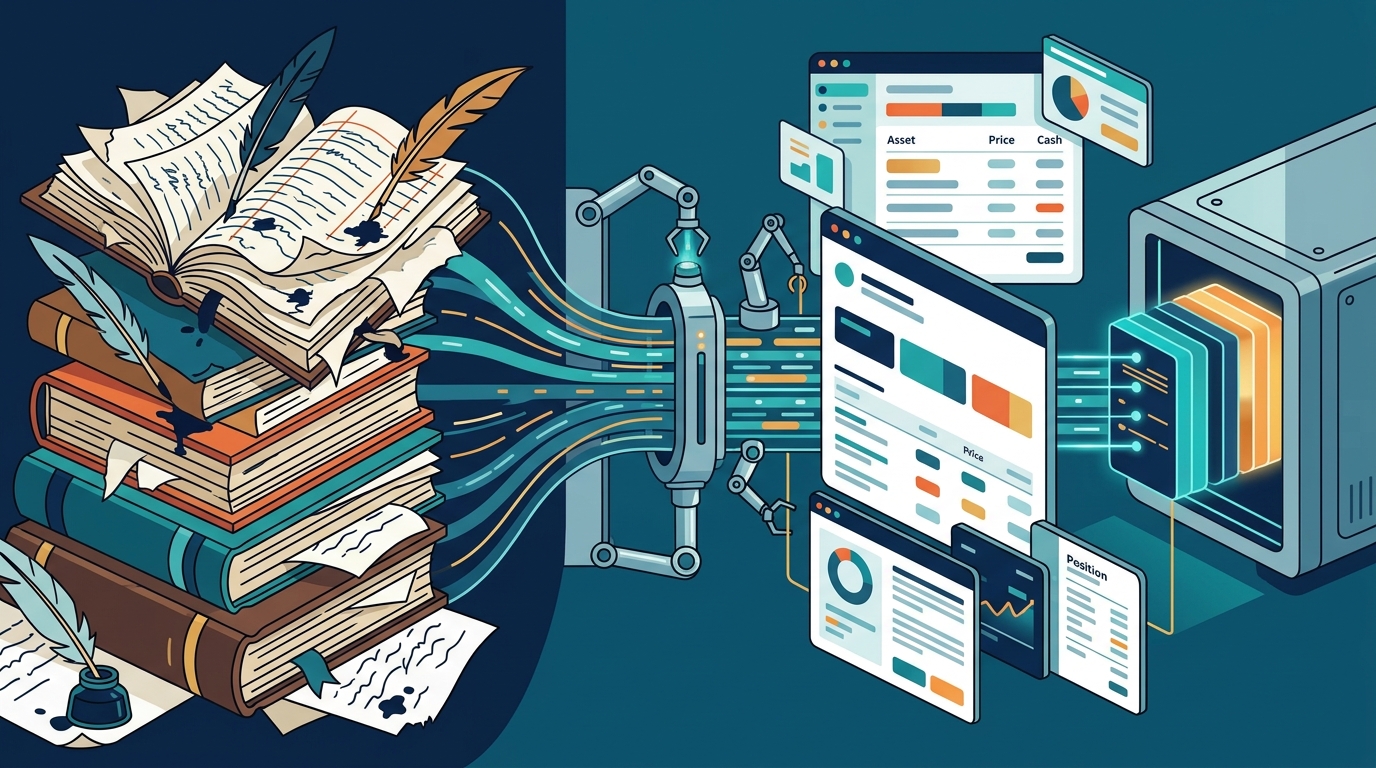
Investment Reconciliation is a primary use case. AI agents match custodian positions against your book of record, resolving corporate action breaks, settlement timing gaps, and pricing discrepancies autonomously. When a transaction does not match, the agent does not simply flag it. It investigates the break, chases source documents, and proposes a resolution with full reasoning attached. This ensures that every action is auditable and every decision is explained.
This approach transforms reconciliation from a periodic, high-stress event into a continuous, real-time process. Agents live in production, monitoring transactions as they occur. This allows finance teams to identify and resolve issues immediately, rather than waiting for month-end close. The result is a clean, auditable close with a complete history of every decision made.
For Expense Reconciliation, agents reconcile credit card feeds, vendor invoices, and expense reports against the general ledger. They flag duplicates and missing approvals automatically. Similarly, Ledger Reconciliation handles intercompany eliminations, multi-entity netting, and GL-to-subledger matching across the entire organizational structure. This comprehensive coverage ensures that no part of the financial ecosystem is left unmonitored.
Key Differences: Manual vs. Autonomous
Understanding the shift from manual to autonomous reconciliation requires looking at the operational mechanics. The table below outlines the critical differences between traditional manual processes and AI-driven agent operations.
| Feature | Manual Ledger Matching | AI Agent Reconciliation |
|---|---|---|
| Investigation | Human-driven, slow, prone to bias | Autonomous, instant, data-driven |
| Audit Trail | Fragmented, often incomplete | Full, immutable, and detailed |
| Scalability | Linear, limited by headcount | Exponential, handles volume spikes |
| Error Rate | Higher, due to fatigue | Near-zero, consistent performance |
| Time to Go-Live | Immediate but inefficient | Weeks, not months |
The shift to AI agents is not just about speed. It is about reliability and governance. Autonomous agents provide a deterministic guardrail that ensures safe, predictable behavior. They are engineered for specific enterprise workflows, meaning they understand the nuances of financial services, logistics, and manufacturing. This domain-specific expertise allows them to handle complex edge cases that would stump generic automation tools.
Integration Capabilities
For AI agents to be effective, they must integrate seamlessly with existing enterprise infrastructure. Aetherix Systems specializes in designing multi-agent architectures tailored to specific workflows. These agents integrate with your existing tech stack, including ERP systems like SAP and Oracle, CRM platforms like Salesforce and HubSpot, and data warehouses like Snowflake and BigQuery.
In the context of investment funds, this means connecting directly to custodian feeds, bank statements, and internal general ledgers. The agents pull data from these sources, auto-match positions, cash, and transactions, and then investigate any breaks. This end-to-end integration ensures that the reconciliation process is holistic and accurate.
Performance analytics provide full visibility into every agent's operations. You can track task completion, accuracy, and operational efficiency with comprehensive reporting. This transparency allows finance leaders to optimize their operations continuously. The agents improve over time through feedback loops and supervised fine-tuning, ensuring that the system becomes more accurate and efficient with every cycle.
Compliance and Security
Security and compliance are paramount in the financial services industry. Aetherix Systems maintains rigorous compliance with global data protection regulations, AI governance frameworks, and security standards. Our multi-jurisdictional approach ensures your data is protected wherever you operate.
The platform is compliant with SOC 2 Type II, ISO/IEC 27001:2022, and ISO/IEC 42001:2023. It also adheres to GDPR, UAE PDPL, EU AI-ACT, HIPAA, and CCPA. This comprehensive compliance framework ensures that your reconciliation operations meet the highest standards of data privacy and security.
Every agent operates within precisely defined safety boundaries. We implement human-in-the-loop controls, full audit trails, role-based access, data residency compliance, and SOC 2 aligned security practices. Data is encrypted at rest (AES-256) and in transit (TLS 1.3). This ensures that sensitive financial data is protected from unauthorized access and breaches.
For financial institutions, this means that your reconciliation operations are not only efficient but also fully compliant with regulatory requirements. The audit trail provides a clear record of every action taken, which is essential for regulatory reporting and internal audits. This level of transparency is difficult to achieve with manual processes.
Key Takeaways
- Operational Efficiency: AI agents handle the full reconciliation lifecycle, from data ingestion to exception resolution, reducing time to close by weeks.
- Auditability: Every action is logged and explained, providing a full audit trail that manual processes often lack.
- Scalability: Autonomous operations can handle volume spikes without the need for additional headcount.
- Security: Enterprise-grade security includes SOC 2, GDPR, and HIPAA compliance, ensuring data protection.
- Integration: Seamless integration with NetSuite, Sage Intacct, QuickBooks, Microsoft Dynamics, and other major platforms.
- Accuracy: AI agents reduce error rates by automating complex matching and investigation tasks.
- Domain Expertise: Purpose-built agent teams understand the specific nuances of financial services and other high-stakes industries.
Frequently Asked Questions
What is the primary benefit of using AI agents for ledger reconciliation?
The primary benefit is the ability to autonomously investigate breaks and propose resolutions with a full audit trail, ensuring accuracy and compliance without manual intervention.
How does AI agent reconciliation differ from traditional automation?
Traditional automation follows rigid rules, while AI agents can reason, decide, and act, allowing them to handle complex edge cases and unstructured data effectively.
Is AI agent reconciliation secure for financial data?
Yes, Aetherix Systems maintains rigorous compliance with SOC 2, GDPR, HIPAA, and other global standards, ensuring enterprise-grade security for all data.
Which platforms does Aetherix Systems integrate with?
We integrate with major ERP and accounting platforms including NetSuite, Sage Intacct, QuickBooks, Microsoft Dynamics, Bill.com, and Ramp.
How long does it take to implement AI agent reconciliation?
Implementation is rapid, with go-live times measured in weeks rather than months, due to our pre-built agent architectures and seamless integration capabilities.
Can AI agents handle intercompany eliminations?
Yes, our ledger reconciliation agents handle intercompany eliminations, multi-entity netting, and GL-to-subledger matching across your entire structure.
What industries does Aetherix Systems serve?
We serve family offices, fund administrators, investment managers, and financial institutions, providing tailored solutions for high-stakes industries.
Next Steps
Stop letting manual processes slow down your financial close. Transition to autonomous, AI-driven reconciliation operations that are accurate, auditable, and secure. Book a scoping call with Aetherix Systems to see how our agents can transform your reconciliation workflow. Visit our contact page to get started.