

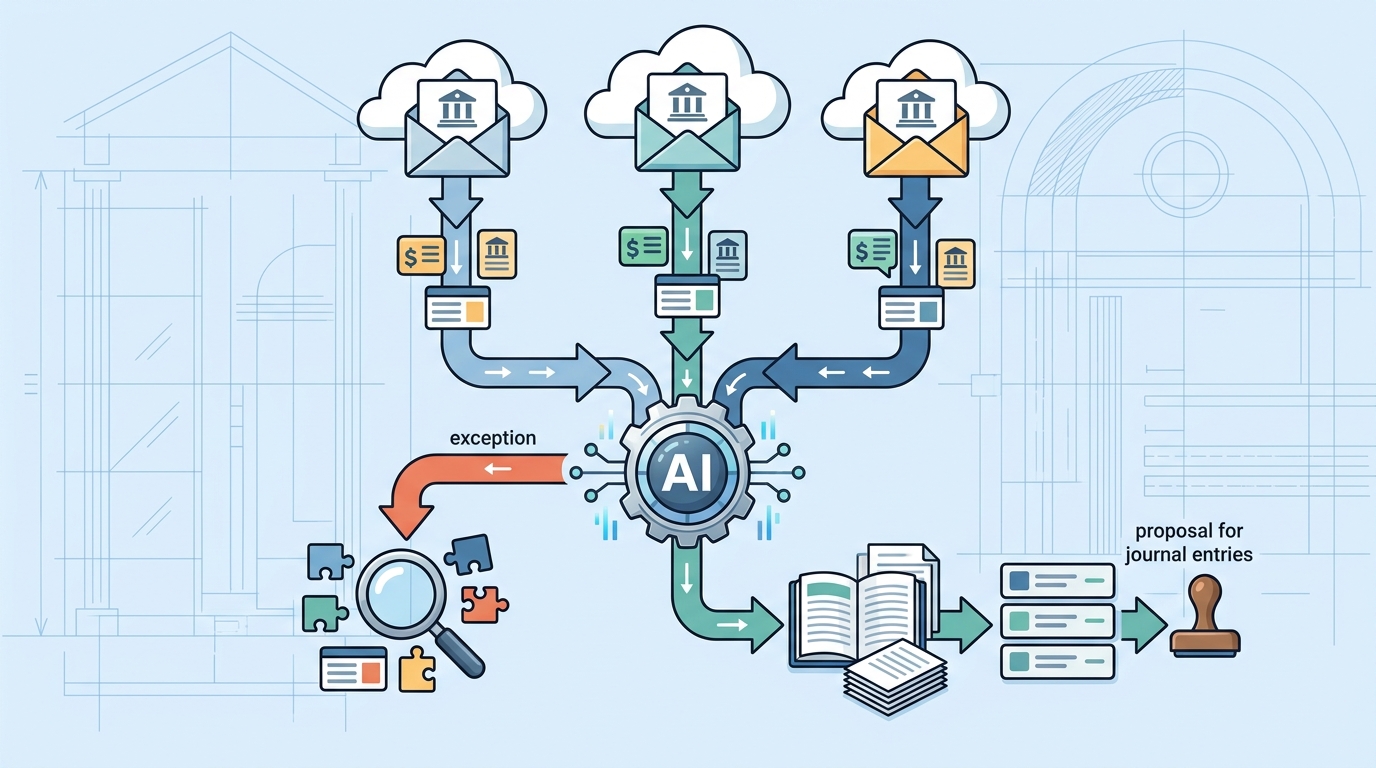
AI agents handle reconciliation exceptions by autonomously investigating mismatches, validating data across multiple custodians, and proposing corrective journal entries for human review. Aetherix Systems builds these agentic workflows to reduce manual close time for finance teams managing complex multi-custodian environments. For additional details, review the Project not found.
The Complexity of Multi-Custodian Reconciliation
AI agents change this dynamic by acting as autonomous investigators. An AI agent is an autonomous software system that can perceive its environment, reason about problems, and take actions to achieve specific goals. In reconciliation, these agents do not just flag errors; they actively search for the missing link. They cross-reference transaction data, check for timing differences, and identify duplicate entries. This shift from passive flagging to active investigation is the core value of agentic reconciliation. For additional details, review the Customer Experience.
How Agentic Workflows Investigate Exceptions
When an exception is detected, the AI agent initiates a structured investigation workflow. It begins by normalizing the data from each custodian into a common schema. This ensures that a trade reported by one custodian can be accurately compared against a record from another. The agent then applies a series of logical checks. It looks for common issues like currency conversion errors, fee discrepancies, and settlement date mismatches. according to AI Agents for For additional details, review the Frequently Asked Questions.
Human-in-the-Loop Validation and Control
Automation in financial operations requires strict human oversight. Aetherix Systems designs its agents to operate under a human-in-the-loop model. This means the AI proposes, but a named client employee disposes. The agent presents its findings and proposed journal entries in a clear, reviewable format. The human reviewer validates the logic and approves the action. This ensures that no financial statement is closed without human accountability. For additional details, review the About.
Reducing Close Time and Operational Burden
The primary benefit of agentic exception handling is the reduction of manual effort. Finance teams often spend significant hours each month resolving reconciliation exceptions. AI agents can process hundreds of exceptions in parallel, drastically reducing queue times. This allows teams to focus on high-value analysis rather than repetitive data entry. The result is a faster, more predictable month-end close process.
By automating the investigation phase, organizations can achieve a higher first-pass resolution rate. Exceptions that would previously sit in a queue for days are resolved within hours. This speed improves cash flow visibility and financial reporting accuracy. It also reduces the risk of errors introduced by manual fatigue. The operational burden shifts from manual data manipulation to strategic oversight and exception approval.
Key Takeaways
- AI agents investigate reconciliation exceptions by normalizing data and applying logical checks across multiple custodians.
- Agentic systems move beyond passive flagging to active root-cause analysis, reducing manual investigation time.
- A human-in-the-loop model ensures that AI-proposed journal entries are validated by a named employee before posting.
- Full audit trails are generated for every agent action, supporting compliance and internal control requirements.
- Automation reduces close time by processing exceptions in parallel, improving financial reporting speed and accuracy.
- Traditional rules-based engines flag mismatches but do not resolve them; AI agents bridge this gap.
Frequently Asked Questions
Do AI agents post journal entries automatically?
No. AI agents propose journal entries and document their reasoning. A named client employee reviews and approves the entry before it is posted to the general ledger. This human-in-the-loop approach ensures accountability and control.
How do AI agents handle data from different custodians?
Agents normalize data from various custodians into a common schema. They use natural language processing to parse unstructured formats like PDFs and emails. This allows for accurate cross-referencing and matching across disparate data sources.
What is an audit trail in the context of AI reconciliation?
Can AI agents handle complex, multi-step exceptions?
Yes. Agentic workflows are designed to handle complex scenarios. They can perform multi-step investigations, such as checking for timing differences, fee discrepancies, and currency conversion errors. The agent documents each step of the investigation.
How does this improve month-end close?
By automating the investigation of exceptions, AI agents reduce the time spent on manual reconciliation. This allows finance teams to close the books faster and with greater accuracy. The reduction in manual effort frees up time for strategic analysis.
Is human oversight required for AI reconciliation?
Yes. Human oversight is a critical component of the workflow. A named employee must review and approve many AI-proposed adjustments. This ensures that financial statements are closed with human accountability and control. Learn more: Project not found.